

Ask your question

Value Palette Framework
Laatst bijgewerkt op: 19-03-2026
In an effort to keep healthcare in the Netherlands under control, there is a growing emphasis on the guiding principle: 'By yourself if possible, at home if possible, and digitally if possible.' Given all the challenges in healthcare, it is necessary to accelerate the implementation of digital and hybrid healthcare. A standardised method for assessing the value of digital and hybrid healthcare helps healthcare organisations make the right choices. But how do you measure the added value in practice?
What is Value Palette Framework?
Vilans has developed a Value Palette Framework to assess the value of hybrid and digital healthcare applications. Value Palette Framework assists researchers in determining how (digital) interventions contribute to the quality, accessibility, affordability, and sustainability of healthcare.
The Value Palette Framework offers a structured and iterative approach to providing insight into the value and impact of interventions. In doing so, it is essential to place equal emphasis on different forms of value. This means that both tangible and intangible costs and benefits are taken into account. In this way, attention is not only paid to savings in money and time but also to the quality of life of clients, job satisfaction of healthcare workers and the reduction of workload.
Steps in the Value Palette Framework
The Value Palette Framework consists of 14 steps, divided into 3 phases:
- Phase 1: examine the context and collect existing knowledge. In this phase, you work towards a clear problem definition and set the guidelines for research in phase 2.
- Phase 2: gather new knowledge. In this phase, you conduct research and gather new evidence for the effectiveness of a digital or hybrid care process.
- Phase 3: share knowledge. In this phase, you write up your research results in a clear manner so that both healthcare practitioners and fellow researchers can immediately put them to use.
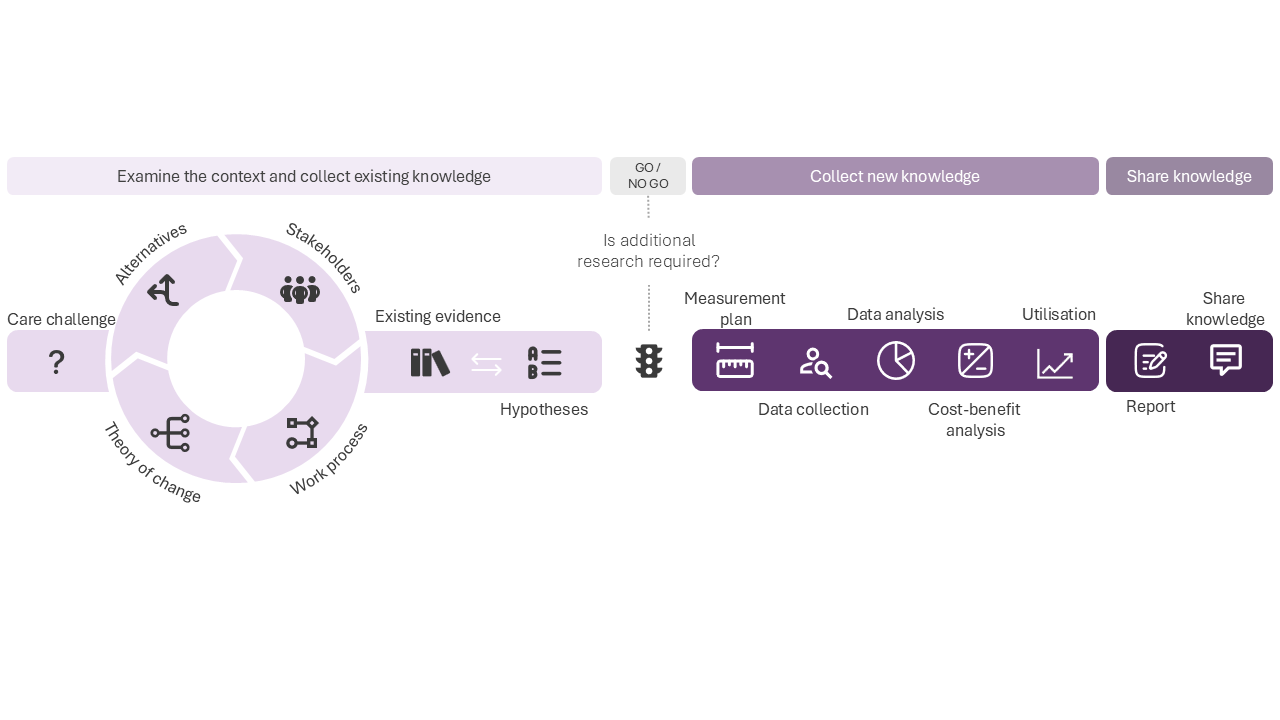
Vilans
Phase 1: examine the context and collect existing knowledge
The Value Palette Framework starts by defining the problem that the intervention is intended to address. Subsequently, the context in which the intervention will be applied is then examined iteratively. This involves:
- identifying the relevant stakeholders;
- documenting the current and future work processes;
- mapping potential alternatives;
- developing a Theory of Change with an effect map.
The effect map provides a systematic representation of how the intervention adds value to the issue previously defined, including the related changes in activities. It also specifies the expected results and the short- and long-term effects, which together form the basis for developing hypotheses. Finally, existing grey literature and scientific evidence are reviewed to determine what knowledge about the intervention is already available.
Go/No go moment
Is there a lack of information that is crucial for decision-making regarding the testing, application, scaling or financing of an intervention? Then, you may proceed to gather new evidence. In doing so, strike a balance between the time and resources required and the expected benefits of the new knowledge in practice. This should be discussed with an ethics committee and the stakeholders who will need the knowledge to proceed with deploying the intervention.
Phase 2: Collect new knowledge
The expected outcomes form the basis for hypotheses that can be used to gather supporting evidence during research. This evidence is presented in the form of a cost-benefit matrix. This cost-benefit matrix depends on factors such as implementation, client population and supplier costs, and may change over time. Finally, together with stakeholders, map out how the benefits from the cost-benefit matrix can be sustained and how they can be utilised.
Phase 3: Share knowledge
To determine the value of innovations, it is important to share the knowledge gained. In this way, you contribute to the national and international knowledge base surrounding interventions in long-term care. This also prevents the same research from being carried out in multiple places. That would be a waste of time and effort.
Would you like to contribute to knowledge development? Share your knowledge with Vilans so that it can be included in the Digital Care Knowledge Base by Vilans (in Dutch).